● Threat Actor Attribution & CTI

Who is targeting your organization — and what do they want?

Knowing you were attacked is not the same as knowing who attacked you, why, and what they will do next. Threat actor attribution maps adversary identity, objectives, capabilities, and infrastructure — giving your team the intelligence needed to defend effectively and anticipate future activity.

The Intelligence Problem

Most incident response stops at remediation. Attribution answers the harder questions.

Technical indicators get patched. The adversary does not go away. Understanding who is behind an attack, what their objectives are, and what infrastructure they control is what allows you to get ahead of the threat — not just clean up after it.

🎯

Unknown Adversary Intent

Without attribution, you cannot know whether an attacker was after data, access, disruption, or espionage — and whether the attack is finished or just beginning.

🔄

Recurring Campaigns

Actors who successfully breach a target rarely stop. Attribution identifies patterns that predict re-engagement and enables proactive blocking of new infrastructure before it's used.

📊

Board and Regulatory Demands

Executives, boards, and regulators increasingly expect an answer to "who was responsible?" Structured attribution provides defensible, evidence-based conclusions with confidence levels.

🛡️

Misaligned Defense

Generic defenses miss actor-specific TTPs. Knowing the adversary — their tools, techniques, and targeting priorities — allows your team to tune controls to the actual threat.

When This Is Needed

Attribution applies both during and after an incident — and proactively

You do not need an ongoing breach to commission attribution research. Understanding which actors are actively targeting your sector, geography, or organization type is valuable intelligence at any time.

During or After a Breach

Parallel to incident response — identifying the actor while remediation is underway allows the response to be calibrated to the adversary's likely next moves.

Unexplained Intrusion Activity

Suspicious activity without clear attribution — unusual access patterns, lateral movement, or data staging — that your internal team lacks resources to fully investigate.

Sector-Specific Threat Landscape

Commissioned proactively — understand which APTs and cybercriminal groups are currently active against organizations in your sector, geography, or size profile.

M&A and Investment Due Diligence

Understanding whether a target organization is being actively pursued by a known threat actor — and whether prior breaches have been fully contained — is material due diligence.

What We Investigate

Technical indicators, infrastructure, and adversary behavior patterns

Attribution analysis draws on incident data, threat intelligence databases, OSINT, dark web monitoring, and proprietary actor tracking to build a structured adversary profile.

What You Receive

A structured attribution report with confidence levels and defensive recommendations

Every attribution conclusion is presented with an explicit confidence level — Low, Medium, High, or State-Adjacent — based on the volume and quality of evidence supporting it. We do not speculate.

Attribution confidence spectrum

Opportunistic / unknown Targeted, origin unclear Known actor, high confidence State-adjacent
How It Works

Structured. Evidence-graded. Defensible to leadership and counsel.

Duration: 3–8 weeks
📋 Engagement type: Project-based
📁 Data required: Incident reports / IOCs (if available)
1

Scope and data intake

We receive available incident data, IOCs, network logs, and malware samples — or proceed from an open-source starting point if no internal data exists. NDA executed prior to any data transfer.

2

Technical indicator analysis

Malware, infrastructure, and behavioral indicators are analyzed and cross-referenced against known actor databases, threat intelligence feeds, and historical campaign data.

3

Open source and dark web research

Actor forums, leak sites, Telegram channels, and paste sites are monitored for activity, claimed responsibility, or data related to your organization or sector.

4

Attribution analysis and confidence grading

Findings are assembled into a structured attribution hypothesis. Each conclusion is graded by evidence quality — and competing hypotheses are presented where evidence does not support a single conclusion.

5

Report delivery and briefing

Technical and executive versions of the report are delivered. A briefing call covers findings for the security team. A separate board/leadership summary is available on request.

Anonymized Example

From intrusion to adversary profile

Details have been modified to protect client confidentiality.

European Technology Company · Series C · Suspected targeted intrusion

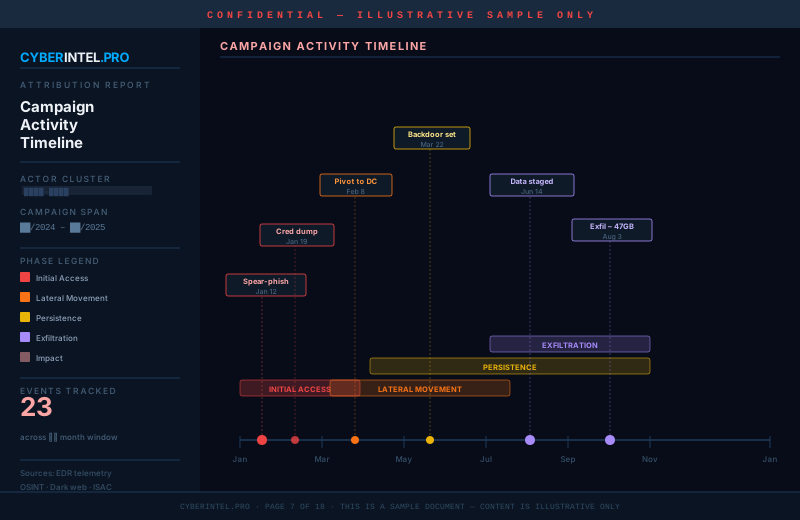
A European software company discovered unusual data access patterns — low-volume, slow-moving lateral movement consistent with a deliberate, long-duration operation rather than an automated scan. Their MSSP had flagged the indicators but could not attribute or characterize the actor.

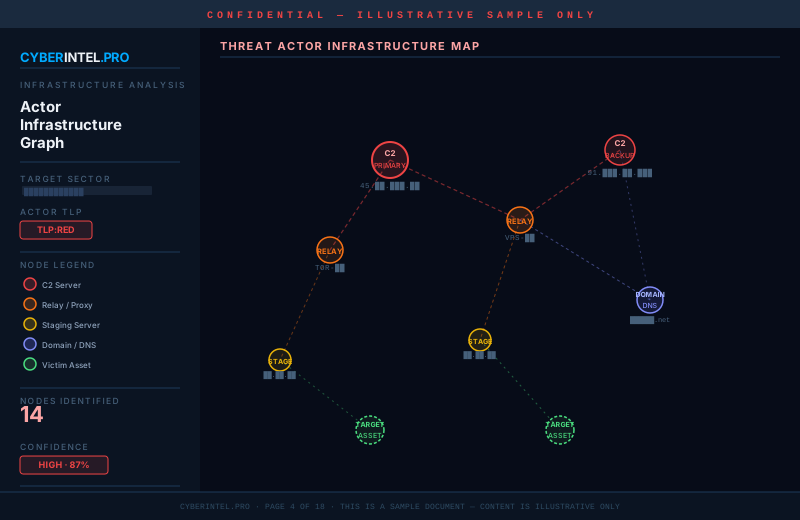
Analysis of the implant used revealed a code family previously observed in three separate campaigns against European software supply chain companies over eighteen months. The C2 infrastructure was partially shared with a campaign attributed with medium-high confidence to a state-adjacent actor with a known interest in European technology transfer. The actor's dark web presence confirmed active access brokering in the software and SaaS sector.

Attribution reached medium-high confidence (targeted, state-adjacent). The company pre-emptively blocked 27 additional IPs from the identified infrastructure cluster, notified relevant authorities, and briefed their board and insurance carrier with the structured attribution report.
FAQ

Common questions

Can you attribute an attack if we don't have technical indicators?
Yes. Behavioral indicators, targeting patterns, timing, and contextual information can support an attribution analysis even without malware samples or IOCs. The confidence level will reflect what the evidence can and cannot support.
How confident can attribution realistically be?
Attribution is a spectrum, not a binary. We present conclusions at one of four confidence levels based on evidence quality. "Known actor, high confidence" requires multiple corroborating technical and behavioral indicators. We do not present speculation as attribution.
Is attribution useful for legal or regulatory purposes?
The structured report with explicit confidence levels is designed to be presentable to legal counsel, regulators, and insurers. For use in legal proceedings, we recommend discussing specific evidentiary requirements before engagement.
Do you share attribution findings with third parties or governments?
No. Our work product is delivered exclusively to the client. We do not share findings with any government, law enforcement agency, or third party without explicit written authorization from you.
What if the attribution points to a nation-state?
Nation-state or state-adjacent attribution is handled with additional care and clearly flagged in the report. We discuss disclosure considerations with you before delivery and can provide recommendations on appropriate next steps, including legal, regulatory, and communications considerations.

Know who's behind the attack — and what they'll do next

Attribution analysis is most valuable when started early. Contact us to discuss your situation and what an engagement can realistically determine.