Most organizations need strategic and operational threat intelligence — but don't have the budget, headcount, or time to build a mature CTI function from scratch. We provide the intelligence output your security team, leadership, and board need, structured for your specific threat environment.
Commercial threat feeds deliver indicators. They don't tell you which threats are actually relevant to your organization, sector, and geography — or what those threats mean for your specific security posture, gaps, and upcoming decisions.
Thousands of IOCs per day — but no guidance on which actors are actually targeting your industry, your geography, or your specific technology stack.
Raw data requires analysts to synthesize it into actionable conclusions. Without a CTI function, that synthesis doesn't happen — and the data goes unused.
Security teams understand the threat landscape. Boards and leadership often don't — not because the information isn't there, but because it isn't being translated into strategic language.
Without forward-looking intelligence, security investments are driven by what happened last. CTI allows investment and posture decisions to be driven by what is likely to happen next.
CTI consulting works best when the engagement is built around a specific requirement — a threat environment you need mapped, a board that needs briefing, or a retainer that keeps your team continuously informed.
Security teams of 5–30 people who need strategic and operational intelligence but can't justify a full-time senior CTI analyst or threat researcher.
Managed security providers who need CTI research to improve detection quality, produce client reports, or support escalation analysis with sector-specific context.
Banks, fintechs, and investment firms in the Middle East and Eastern European corridors — sectors with elevated, sector-specific threat actor activity requiring dedicated tracking.
Organizations where the board, audit committee, or risk committee requires regular threat intelligence briefings that connect the external threat landscape to business risk.
Every deliverable is written for a specific consumer: technical teams who need to hunt and detect, security leadership who need to prioritize and invest, or executives and boards who need to govern and communicate risk.
Intelligence only works if it reaches the right person in the right form at the right time. Deliverable format is agreed at the start of each engagement to match your team's actual consumption patterns.
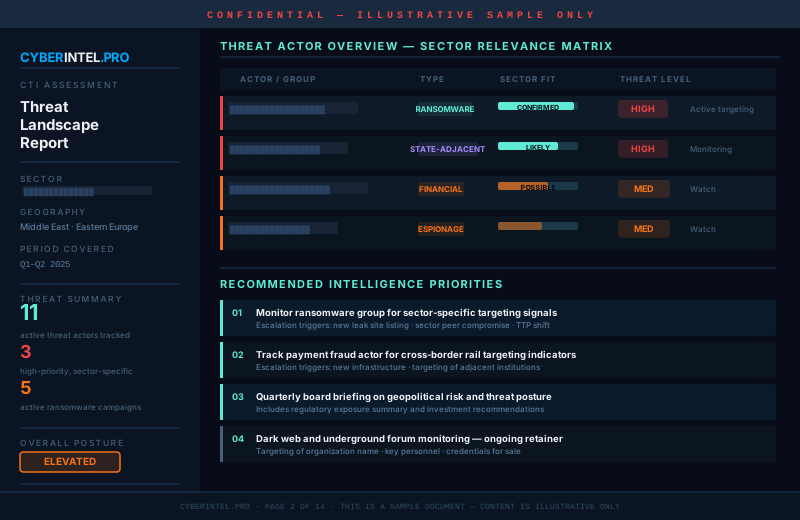
Quarterly or semi-annual assessments of the threat environment relevant to your sector, region, and organization type. Designed for security leadership and board consumption.
Short, timely reports on specific active threats, campaigns, or actor activity — produced when a relevant development requires your security team's attention.
Written for non-technical readers. Connects the external threat landscape to business risk, regulatory exposure, and strategic decisions in language boards can act on.
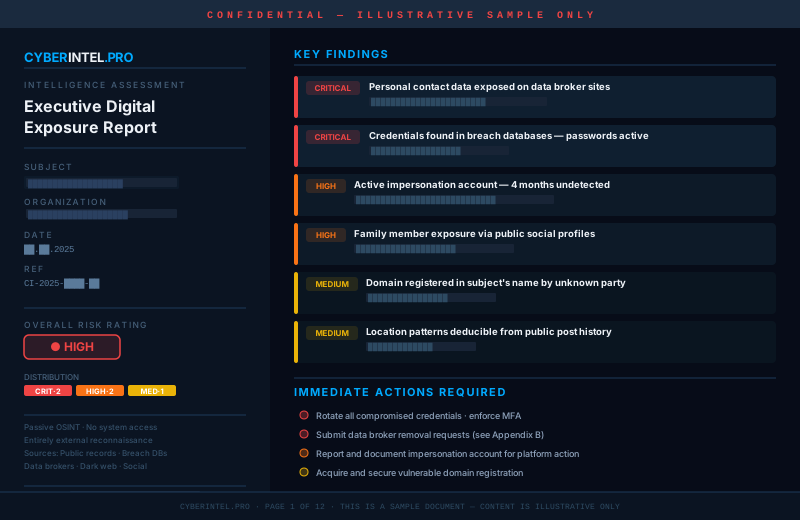
Ad hoc deep dives — a specific threat actor, a sector your organization is entering, a technology you're adopting, or a geopolitical development affecting your operations.
We define your threat environment — sector, geography, technology stack, and the decisions your team and leadership need intelligence to support. This drives every subsequent deliverable.
Identification of which threat actors, ransomware groups, and campaigns are currently active and relevant to your organization — from open, technical, and dark web sources.
Raw research is synthesized into finished deliverables — written, structured, and calibrated for the specific audience receiving each report.
Each deliverable is accompanied by a debrief session — for the security team, for leadership, or for the board — to ensure findings are understood and can inform decisions.
For retainer engagements, continuous monitoring of actor activity, dark web developments, and threat landscape changes — with ad hoc bulletins when significant developments require immediate attention.
Details have been modified to protect client confidentiality.
A European fintech expanding into the Israeli and Eastern European markets commissioned a CTI engagement to understand the specific threat landscape before deployment. Their existing security program was built around Western European threat models and had no visibility into threat actors active in the target regions.
The engagement produced a threat landscape assessment identifying three ransomware groups with active targeting in the Eastern European financial sector, two of which had compromised companies in adjacent sectors in the preceding six months. A second deliverable profiled a financial fraud actor specifically targeting cross-border payment rails of the type the company was deploying. Board briefing materials connected the identified threats to specific business risk — regulatory exposure from data breach notification requirements in new jurisdictions, operational disruption risk during the high-stakes launch window, and reputational risk from association with a sector that had experienced several high-profile incidents.
Most CTI engagements can be scoped in a single conversation. Contact us to discuss your threat environment and what intelligence would make the most difference to your security program.